
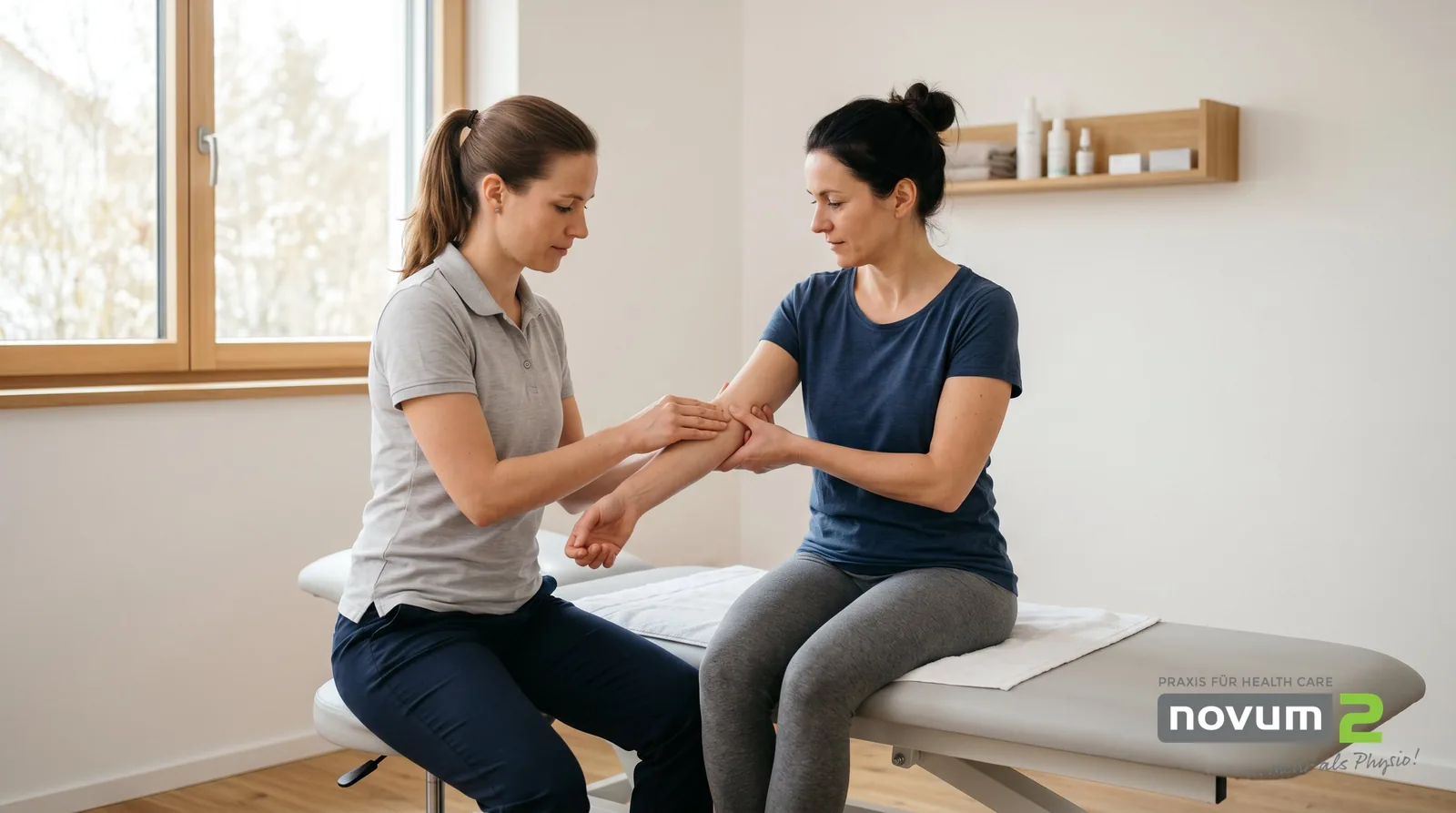
Pain on the outer elbow that flares up suddenly when gripping a coffee cup or shaking hands: that is the typical picture of tennis elbow. The medical term is lateral epicondylitis (epicondylitis humeri radialis). Although the name suggests sport, office workers, tradespeople and musicians are affected far more often than tennis players. At our physiotherapy practice at Ebertplatz in Cologne, we help you understand the causes and make your arm resilient again step by step.
What is tennis elbow (lateral epicondylitis)?
Tennis elbow is an irritation or damage of the tendon attachments of the forearm extensor muscles at the outer elbow prominence, the lateral epicondyle. In many cases it is less a classic inflammation than a degenerative change in the tendon structure: a tendinopathy caused by repeated micro-trauma. Under constant load, the tendons do not recover fully and lose their load capacity.
Directly opposite, at the inner elbow prominence, sits golfer's elbow (medial epicondylitis). While tennis elbow affects the extensor muscles of the forearm, golfer's elbow affects the flexor muscles. Pain on the outer elbow points to tennis elbow, pain on the inner side to golfer's elbow.
Typical symptoms of tennis elbow
The leading symptom is pain at the outer elbow prominence that increases under load. Other common complaints:
- Weakness when gripping and holding objects (coffee cup, suitcase, door handle)
- Pain when rotating the forearm, for example when opening a screw cap
- Pain on pressure directly on the bony prominence of the outer elbow
- Radiating pain into the forearm or hand
- In pronounced cases, pain even at rest
The complaints usually begin gradually and increase over weeks. Even everyday movements can then become uncomfortable.
Causes and risk factors
Tennis elbow is almost always caused by one-sided, repetitive overload of the forearm extensors. Tennis is less often the trigger than assumed. Typical causes:
- Daily typing and mouse use at the computer
- Manual work such as screwing, painting or sawing
- Heavy lifting with an outstretched arm
- Tennis, especially the backhand with faulty stroke technique
- Playing string instruments
Tension in the shoulder and neck area and unfavourable posture at the desk can also contribute to its development, because they increase the overall tension in the arm-shoulder chain.
Self-test: could it be tennis elbow?
A few simple tests can provide initial clues. They do not replace a physiotherapy assessment.
Cozen's test: Extend your arm and make a fist. Another person presses the fist downwards while you try to bend the hand upwards. Pain at the outer elbow during this is a clear sign.
Middle finger extension test: Extend your middle finger against the resistance of a second hand. Pain at the outer elbow suggests involvement of the extensor carpi radialis brevis, the most commonly affected muscle.
Pain on pressure: Palpate the bony prominence on the outer elbow. Local pain on pressure at exactly this spot is typical of tennis elbow.
If these tests are positive, we recommend a thorough assessment by a physiotherapist before starting exercises on your own.
How is tennis elbow treated?
Physiotherapy is the mainstay of treatment for tennis elbow. We tailor the approach individually to the phase of your complaints.
Reducing irritation in the acute phase
The first priority is to calm the tendon irritation. Cold applications (cryotherapy) can ease acute complaints. Ultrasound and electrotherapy can promote tissue circulation and are used for pain relief. Manual therapy can release accompanying tension in the forearm, the elbow area and the shoulder-neck region.
Eccentric training as the core therapy
Eccentric training is a well-studied method for tendon conditions in current physiotherapy. In eccentric training, the muscle works while it lengthens – i.e. during controlled yielding against resistance. This loading pattern is intended to stimulate the tendon structure to adapt and to strengthen the forearm muscles specifically.
A basic exercise: place your forearm on your thigh, palm facing down. Hold a light dumbbell (0.5 to 1 kg). Slowly lift the hand upwards (dorsal extension), then lower it slowly, supported by the other hand, without letting go of the forearm. The lowering phase is the decisive eccentric component. 3 sets of 10 to 15 repetitions, performed daily.
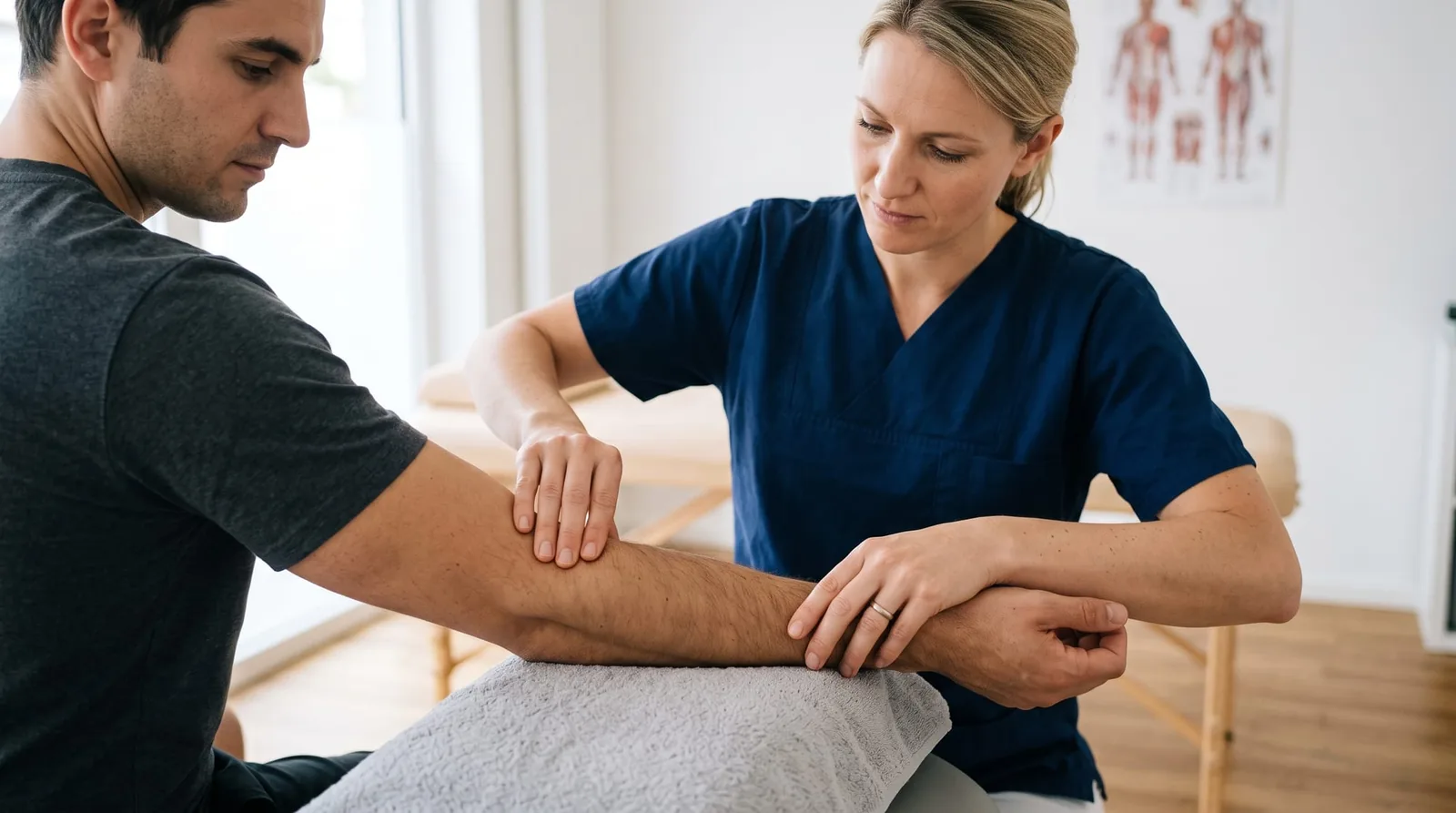
We determine the right dosage together with you. Loading too intensively too early can initially intensify the complaints, which is why a graded approach is important.
Stretching and tone regulation
Targeted stretching exercises for the forearm extensors and flexors reduce the tension in the tissue. In addition, myofascial techniques on the fasciae can improve mobility in the elbow area.
Tennis elbow brace: what does it do in everyday life?
An epicondylitis brace is worn on the forearm a few centimetres below the elbow. It exerts targeted pressure on the forearm muscles and can reduce the tensile forces at the tendon attachment. In the active loading phase, it can ease everyday complaints.
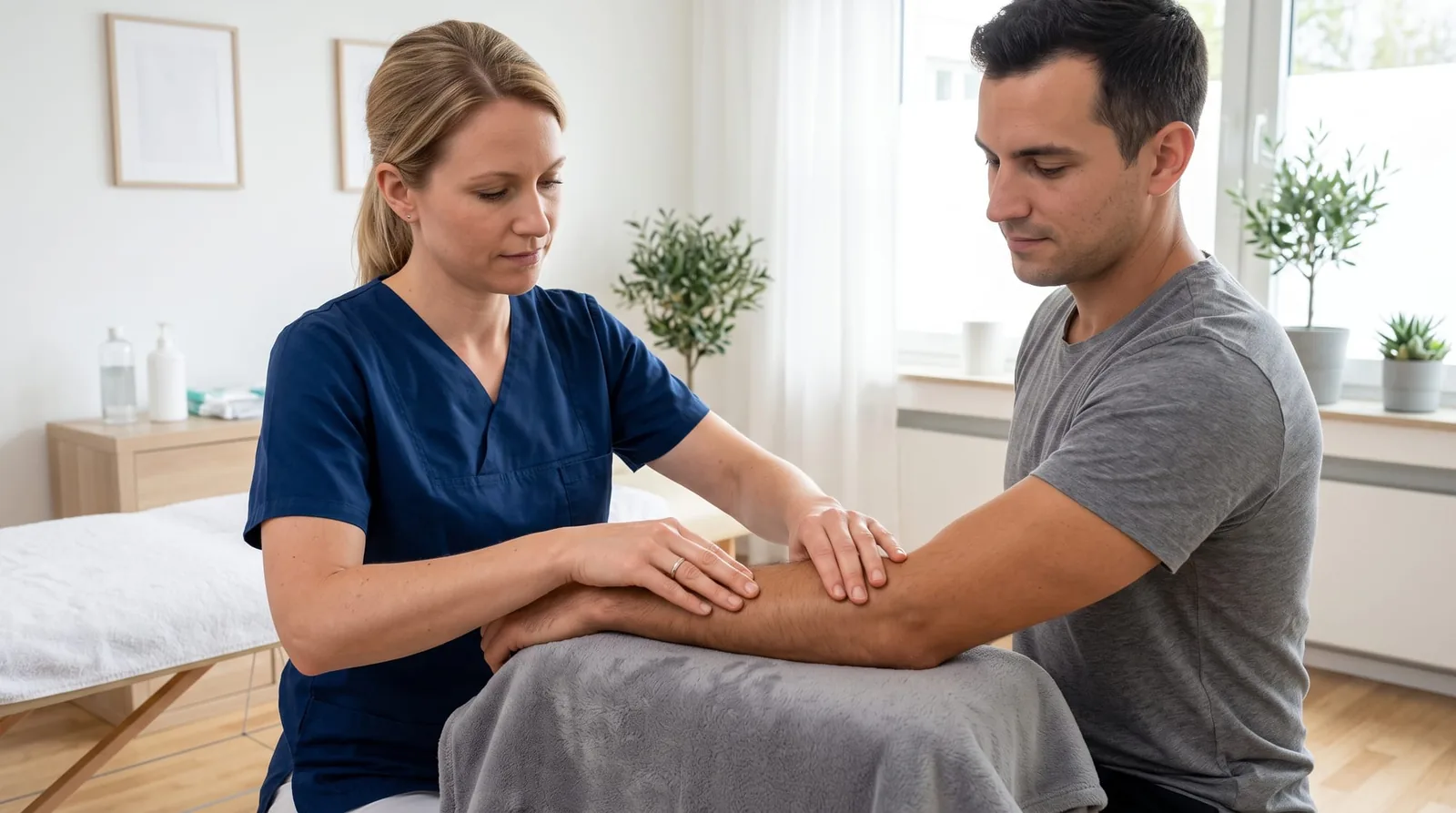
A brace is not a substitute for physiotherapy treatment. It is best used in addition to an active therapy programme. Get advice on fit and positioning.
How long does tennis elbow last?
That depends above all on how early treatment begins and whether the triggering overload can be reduced. Recent cases often respond to physiotherapy within a few weeks. Chronic courses that have existed for months need more time. Tendon tissue regenerates more slowly than muscle tissue, which is why consistency in training is decisive.
Surgical measures are rarely necessary. They are only considered when conservative treatment has not brought sufficient success over many months.
Tennis elbow exercises: what should you pay attention to?
Besides eccentric training, the following exercises can be useful:
- Stretch the forearm extensors: Extend the affected arm, palm facing down. Slowly bend the hand downwards with the other hand until you feel a stretch on the top of the forearm. Hold 3 times for 30 seconds.
- Stretch the forearm flexors: Extend the arm, palm facing up. Bend the hand downwards until you feel a stretch on the underside of the forearm. Hold 3 times for 30 seconds.
- Wrist rotation: Slowly rotate the forearm from inside to outside and back, with a light dumbbell or just the weight of your arm. This exercise promotes the mobility of the wrist and forearm.
All exercises should be performed pain-free or with only a slight pulling sensation. Severe pain during exercise is a signal to reduce the intensity or pause briefly.
Treating tennis elbow in Cologne
With tennis elbow, early, active action makes sense. At our practice at Ebertplatz 2 in Cologne, we first analyse which phase your complaints are in and adapt the treatment programme accordingly. We combine manual therapy, eccentric strength training and electrotherapy with advice on managing load in everyday life.
Book an appointment on +49 221 1693 8485 or by email to info@novum2.de. You can reach us Monday to Friday during our opening hours (Fridays until 4:10 pm).