
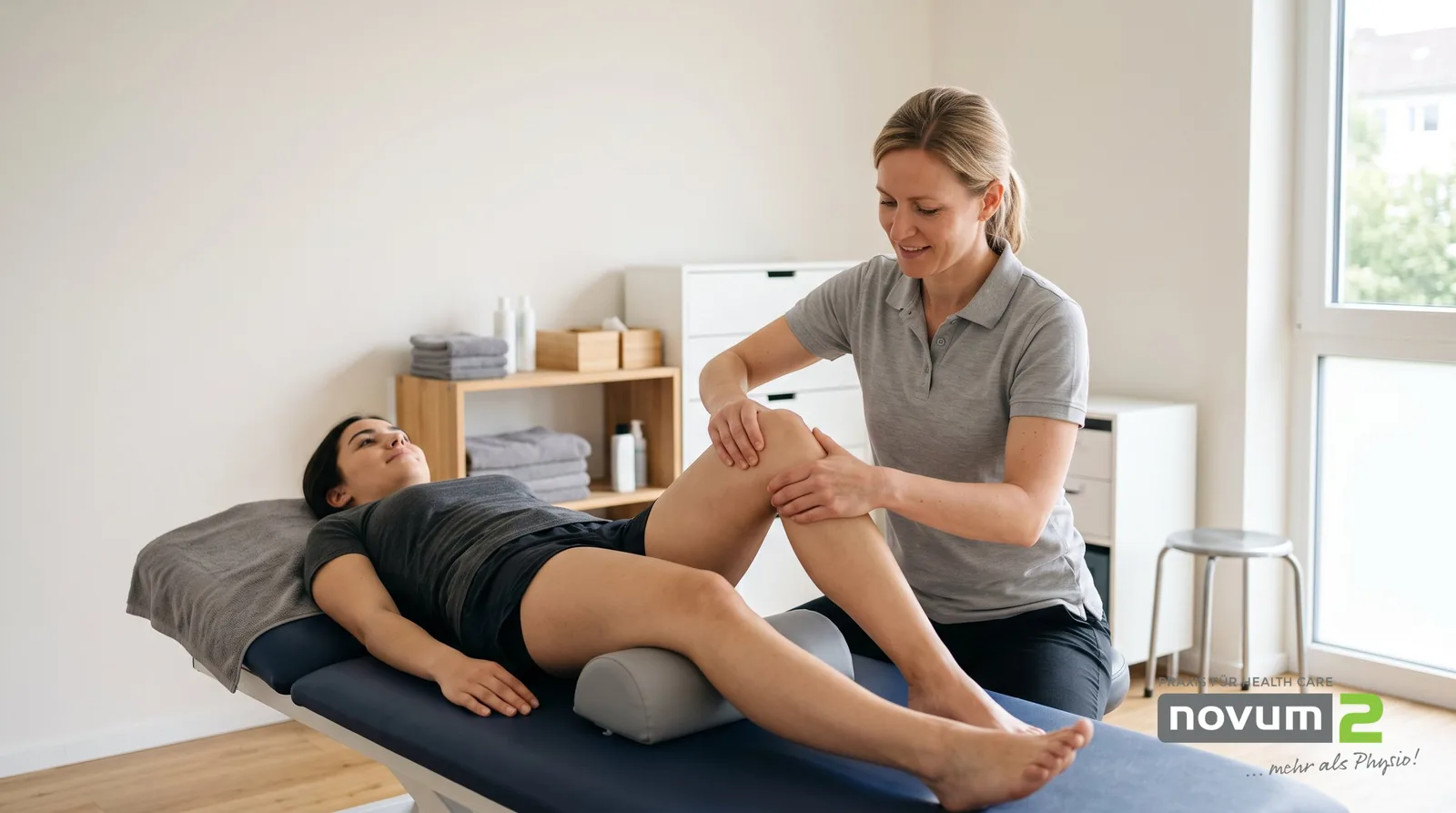
A Baker's cyst, also called a popliteal cyst, is a collection of fluid behind the knee joint. It almost always develops as a result of another knee condition, such as meniscus damage or osteoarthritis. In most cases, a Baker's cyst can be treated conservatively. At our physiotherapy practice at Ebertplatz in Cologne, we help you understand the cause and address it in a targeted way.
What is a Baker's cyst?
A Baker's cyst is a pouch of the joint capsule filled with joint fluid (synovial fluid). It typically forms in the hollow of the knee, directly behind the knee joint. Doctors also call it a popliteal cyst or synovial cyst.
The cyst takes its name from the British surgeon William Morrant Baker, who first described it systematically in the 19th century. The cyst itself is usually not an independent problem. It is a sign that the knee joint is producing too much joint fluid.
The size can vary greatly. Small cysts often cause no complaints. Larger cysts (from around 5 cm) can cause pressure, stiffness and pain.
Symptoms of a Baker's cyst
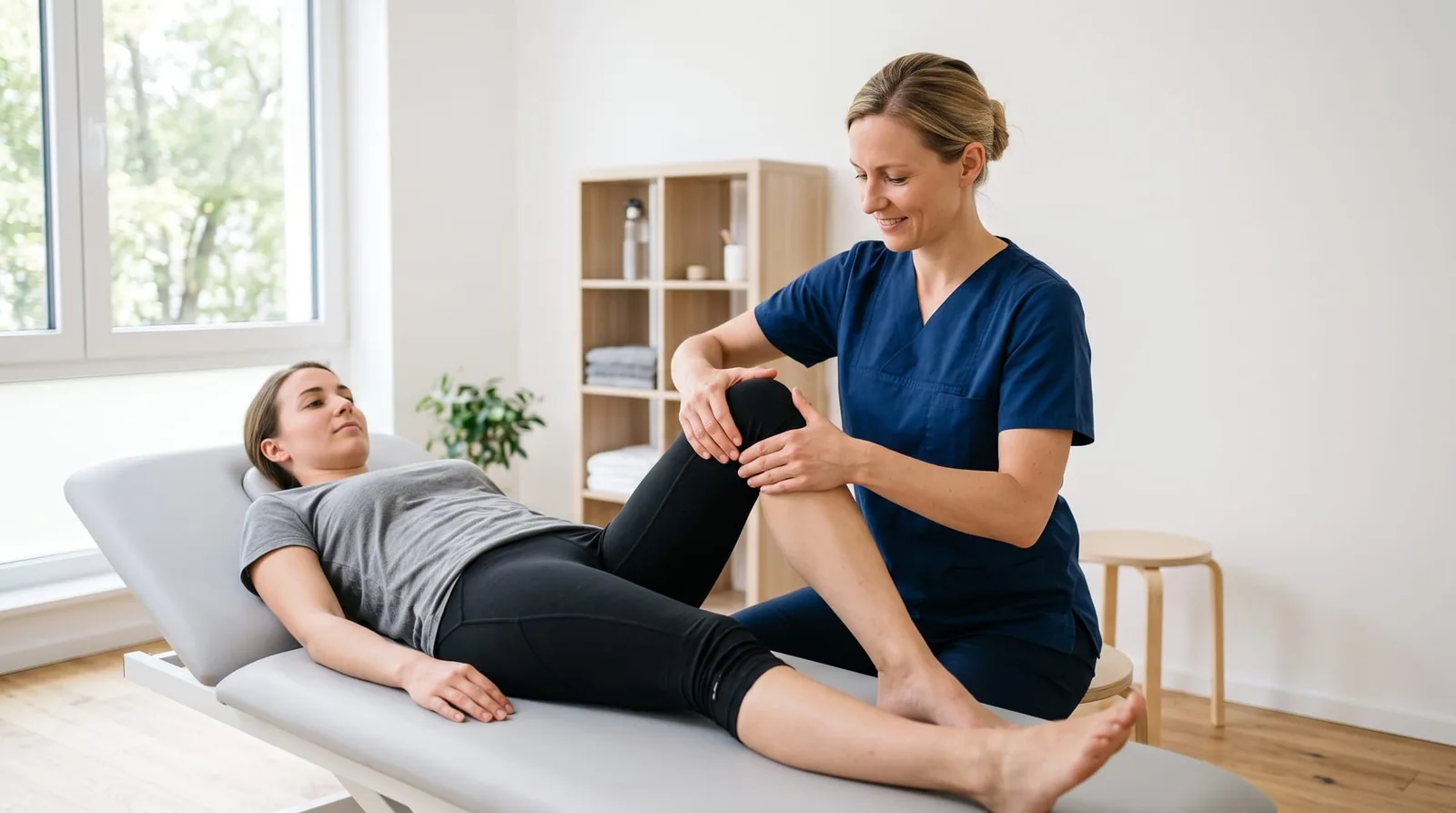
The symptoms of a Baker's cyst depend strongly on the size of the cyst and the underlying condition. Typical complaints are:
- A palpable or visible bulge in the hollow of the knee
- A feeling of pressure or tightness behind the knee
- Stiffness in the knee joint, especially in the morning or after prolonged sitting
- Restricted bending of the knee
- Pain under load or when fully straightening the leg
The complaints often intensify with prolonged standing or walking. At rest they usually decrease.
If a Baker's cyst ruptures, the joint fluid can leak into the surrounding tissue. This causes sudden severe pain, marked swelling and warmth in the calf. These complaints resemble those of a venous thrombosis. In this case, seek medical help immediately.
Causes: why does a Baker's cyst develop?
A Baker's cyst almost never develops without a reason. It is usually based on a condition of the knee joint that causes the joint to produce more fluid. This excess synovial fluid collects in the hollow of the knee and forms the cyst there.
The most common causes are:
- Meniscus damage: A torn or worn meniscus is one of the most common causes. You can read more in our article on meniscus damage.
- Knee osteoarthritis (gonarthrosis): With degenerative cartilage changes, the knee joint permanently produces more joint fluid. Read more about osteoarthritis and its treatment.
- Knee joint effusion: Any inflammation in the knee joint can lead to an effusion, which promotes the development of a Baker's cyst.
- Rheumatoid arthritis: This chronic joint inflammation can also lead to increased joint fluid production and thus to a Baker's cyst.
- Cartilage damage and ligament injuries: Traumatic injuries of the knee joint are also possible causes.
If your knee sometimes makes strange noises, this can also indicate knee problems. Our article on knee cracking explains possible connections.
Diagnosing a Baker's cyst
A Baker's cyst can often be identified by a physical examination alone. The doctor palpates the hollow of the knee and assesses the size, consistency and position of the bulge.
The following examinations can confirm the diagnosis:
- Ultrasound (sonography): Quickly available and without radiation exposure. Well suited for showing the size and position of the cyst.
- MRI (magnetic resonance imaging): Shows not only the cyst but also the cause in the knee joint. Particularly helpful for identifying a meniscus tear or cartilage damage.
Important: treatment always addresses the underlying condition, not the cyst alone.
Treating a Baker's cyst
Therapy depends on the cause and the severity of the complaints. In many cases, no invasive measures are necessary.
Conservative treatment
As a first step, doctors often recommend conservative measures:
- Rest and targeted relief of the knee joint
- Cooling for acute inflammation and swelling
- Heat for chronic complaints without active inflammation
- Compression bandages for support
- Pain-relieving medication as recommended by a doctor
Physiotherapy for a Baker's cyst
Physiotherapy is a central building block of conservative treatment. The focus is not on the cyst itself but on the cause in the knee joint.
At our practice, we work with you on targeted muscle strengthening around the knee, manual techniques for joint relief and an individually adapted exercise programme. The goal is to reduce the mechanical load on the joint and decrease the excess fluid production.
Aspiration of the Baker's cyst
If the cyst is very large and causes considerable complaints, the doctor can draw off the fluid with a needle (aspiration). An anti-inflammatory medication is often injected at the same time. However, aspiration alone does not fix the cause. Without treating the underlying condition, the cyst often returns.
Surgery
Surgery is rarely necessary. It is considered when the underlying condition needs to be treated surgically, the cyst keeps recurring despite conservative therapy, or a rupture has caused complications.
Exercises for a Baker's cyst: what really helps
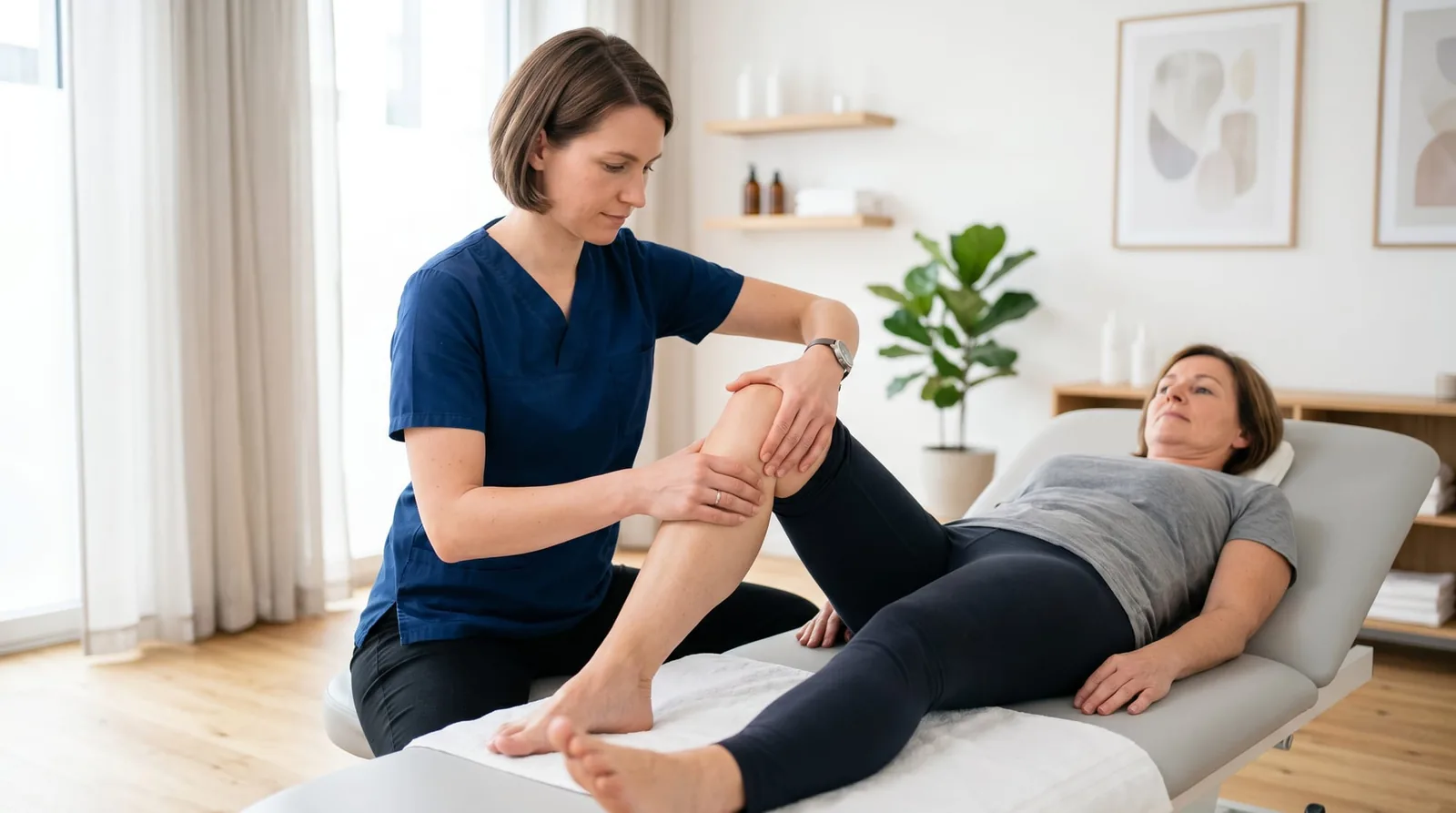
Gentle movement is important with a Baker's cyst. It can promote circulation, strengthen the muscles around the knee and reduce the load on the joint.
Please note: Only perform exercises within a pain-free range. If unsure, talk to us or your doctor before starting.
Recommended exercises
- Strengthen the quadriceps (seated): Sit on a chair. Slowly extend one leg, hold the position for 3 to 5 seconds and lower it again. 3 sets of 15 repetitions per side.
- Stretch the calf muscle: Stand in front of a wall. Extend one leg backwards, keeping the heel on the floor. Stretch gently and hold for 30 seconds. 3 repetitions per side.
- Straighten the knee while lying down: Lie on your back. Place a rolled-up towel under the hollow of the knee. Slowly straighten the knee as far as possible and hold briefly. 3 sets of 15 repetitions.
- Controlled mini squats: Stand with feet hip-width apart. Bend your knees slightly (approx. 30 to 45 degrees), back straight, knees over the toes. 3 sets of 10 repetitions.
These exercises are general recommendations for getting started. An individually tailored programme from a physiotherapist is considerably more effective.
When should you see a doctor?
In the following situations you should seek medical advice promptly:
- The cyst grows quickly or changes visibly.
- Sudden severe pain, swelling and warmth in the calf (possible cyst rupture or thrombosis).
- The knee is severely swollen, red and warm.
- The complaints considerably restrict your everyday life.
- Conservative measures bring no improvement after several weeks.
Baker's cyst in children
Baker's cysts occur less frequently in children than in adults. In children they often develop without an identifiable underlying condition. In many cases, the cyst resolves by itself without specific treatment.
Nevertheless, medical assessment is sensible to rule out other causes. As a rule, a wait-and-see approach is often appropriate for children with a Baker's cyst and no complaints.
Physiotherapy for a Baker's cyst in Cologne
A Baker's cyst shows that your knee joint needs support. The earlier the cause is identified and addressed, the better the chances of avoiding prolonged complaints.
At the Novum2 practice at Ebertplatz in Cologne, we carry out a thorough assessment. Together with you, we develop a therapy plan tailored precisely to your situation. Whether manual therapy, targeted strengthening or advice on everyday relief: we are personally there for you.
Book your appointment via the contact form or by phone on +49 221 1693 8485. You can reach us Monday to Friday during our opening hours (Fridays until 4:10 pm).