
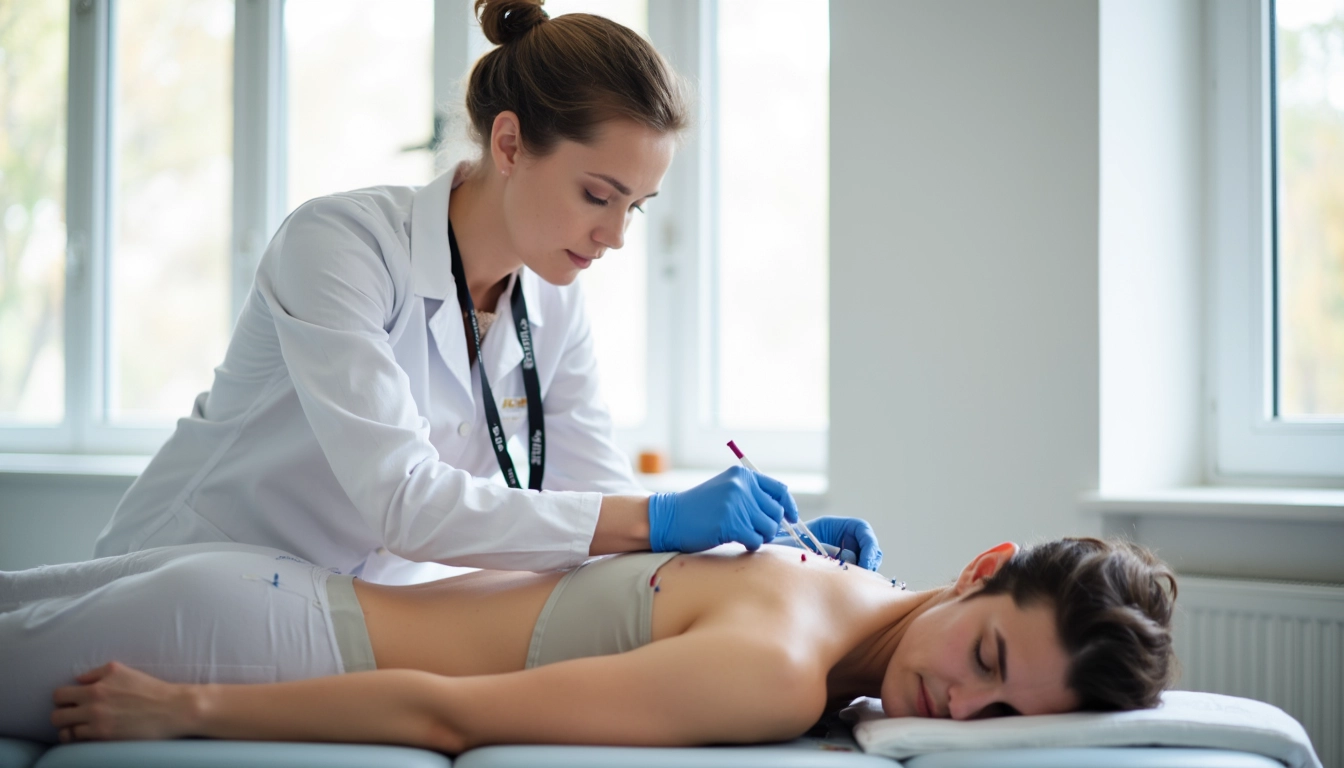
In brief
What is dry needling?
Trigger point: A hyperreactive knot in the muscle that triggers referred pain.
Imagine a short circuit in your muscle's electrical system – dry needling is the "reset" that restores conductivity.
Dry needling is not acupuncture but applied neuroscience: while acupuncture is based on meridians, dry needling works with the neurofascial matrix.
Targeted needling of trigger points elicits the local twitch response – a neurophysiological reflex that:
- Stimulates ATP release for muscle relaxation,
- Lowers CGRP levels (calcitonin gene-related peptide) to reduce inflammation,
- Interrupts pain memory formation in the spinal cord.
At our Cologne practice, we combine this with fascial mobilisation to restore the body's tensegrity model – a systems approach in which muscles and connective tissue are treated as a connected network.
"With chronic neck pain we often work with the levator scapulae muscle – a typical 'victim muscle' in office patients. With dry needling we not only release the knot but also normalise the proprioceptive feedback" – Kamal Habib
Which complaints does dry needling work for?
| Complaints | How dry needling helps |
|---|---|
| Neck and shoulder pain | Releases tension, reduces pain and improves mobility |
| Back pain | Reduces pain and promotes the recovery of hardened muscles |
| Sports injuries | Can support regeneration, e.g. with strains or tendinitis |
| Headaches and migraine | Eases complaints caused by muscle tension |
| Restricted mobility | Improves flexibility and supports rehabilitation |
Myofascial pain syndrome: Chronic dysfunction of the muscle-fascia unit with activated trigger points as pain generators.
Case study from Cologne: from vicious circle to solution
"Mr M., 42, an office worker with chronic neck pain (VAS 8/10), had tried massage and NSAIDs without success. In the 3rd dry needling session we focused on the sternocleidomastoid muscle – an often overlooked silent trigger point. The combined treatment with postural training reduced the pain to VAS 2/10. Why? The needling normalised muscle spindle activity, which is essential for postural control."
Why for chronic pain?
Chronic pain often follows the pain memory model:
- Peripheral sensitisation (trigger points)
- Central sensitisation (spinal cord/brain)
- Neuroplastic maladaptation
Dry needling breaks this cascade through:
Peripheral desensitisation (ATP release in muscles)
Central reorganisation (DPMS activation via Aδ fibres)
Your dry needling treatment at NOVUM2 in Cologne
At our practice we use dry needling particularly for:
- "Start-up neck": IT workers with suboccipital trigger points
- "Carnival knee": Recurring quadriceps hardening after dance marathons
- Rhineland master gardeners: Chronic lumbar restrictions from one-sided loading
"Each patient group requires a different needling pattern – with office patients we often work with the deep front line according to Myers to release postural stress."
– Kamal Habib, pain specialist
What are the benefits of dry needling?
Neuroplastic reset: Dry needling uses the homeostatic plasticity of the nervous system – it "re-learns" freedom from pain.
| Benefit | Molecular mechanism | Clinical effect (Cologne example) |
|---|---|---|
| 1 Immediate pain relief | Release of β-endorphins and adenosine (natural pain blockers) | Office workers with neck pain: VAS reduction from 7→3/10 within 24 hrs |
| 2 Deep relaxation | Lowering of substance P (pain mediator) + CGRP (inflammatory messenger) | can help ease piriformis complaints – course varies individually |
| 3 Freedom of movement | Normalisation of muscle spindle activity (proprioception) | Dancers with stiff hips: ROM improvement of 40° in 2 weeks |
| 4 Systemic regeneration | Stimulation of fascial fibroblasts (collagen remodelling) | used e.g. for frozen shoulder to support mobility – course varies individually |
Case study: marathon runner from Cologne
"Ms K., 35, suffered from chronic Achilles tendon irritation. Conventional therapies brought only short-term relief. Targeted dry needling of the gastrocnemius muscle (calf area) stimulated collagen synthesis – measured via ultrasound elastography. Over the course of treatment the tendon stiffness was measurably reduced. Why? The needling activated tenocytes, the repair cells of the tendons."
Why safe? A look under the microscope
The minimal invasiveness is explained by:
- Thin needle gauge (0.16–0.30 mm vs. injection needle: 0.9 mm)
- No pharmaceuticals: Avoids side effects such as liver strain
- Precise control via palpation diagnostics (tactile accuracy <2 mm)
"Like a surgical scalpel for muscles – precise, controlled, without scars."
Long-term effect: more than symptom relief
- Local: ATP release → muscle relaxation
- Segmental: Inhibition of the pain matrix in the spinal cord
- Central: Activation of the descending inhibitory pathway (brain→spinal cord)
Current state of research: Reviews suggest that dry needling, as part of a comprehensive treatment plan, can help relieve pain and reduce recurring complaints. The extent and duration of the effect vary from person to person.
A comprehensive approach at NOVUM2 in Cologne
At our practice, we always combine dry needling with:
Postural analysis (posture patterns according to Janda)
Fascial chain training (e.g. spiral lines according to Myers)
Neurocentric coaching (explanation of pain physiology)
What can you expect during a dry needling treatment?
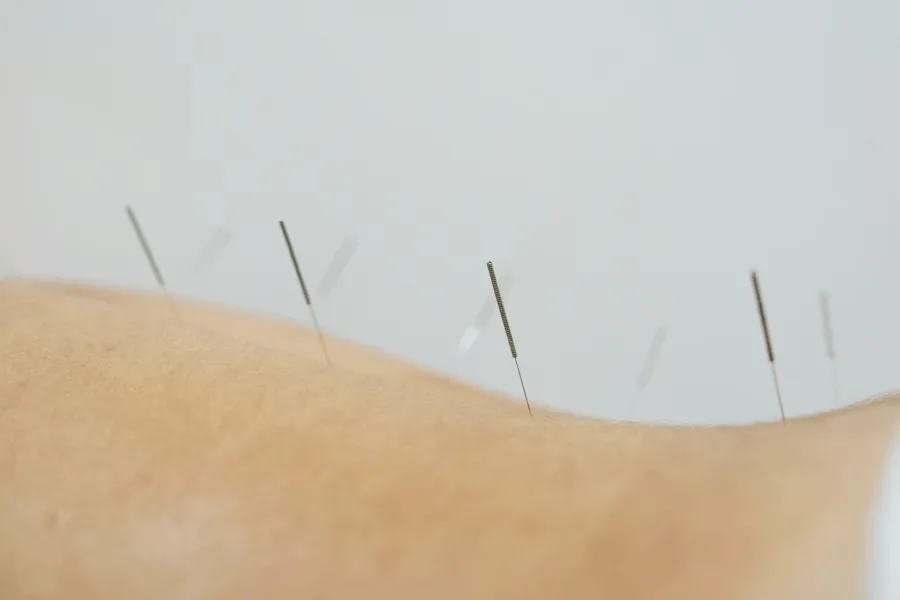
Risk profile vs. safety measures
| Risk factor | Preventive measure | Scientific evidence |
|---|---|---|
| Infection | Sterile technique and skin antisepsis | No infections when the protocol is followed |
| Bleeding | Anticoagulant screening before treatment | Lower risk than with injections |
| Fainting | 30° elevated upper body position | reduces the risk of circulatory reactions |
| Nerve injury | Ultrasound-guided needle placement | increased safety in sensitive zones |
| Documentation | Complete treatment documentation |
|
Case example: safety in practice
"Ms S., 58, needed blood thinners (Marcumar®) after heart surgery. Through precise INR adjustment (target value 2.5) and 27G micro-needles (0.21 mm), we were able to perform dry needling on the trapezius muscle safely – without haematomas. Our protocol: 5 min. of pressure with a silicone pad post-treatment."
The local twitch response (LTR): the biomechanical feedback system
Local twitch response (LTR): Involuntary, brief muscle contraction (50–100 ms), triggered by mechanical stimulation of an active trigger point.
Neurophysiology of the LTR: from needle prick to pain relief
- Mechanotransduction: The needle stimulus activates mechanoreceptors (e.g. Piezo1 channels) in the muscle fibre.
- Neurochemical cascade:
- Release of ATP → relaxes contracted sarcomeres
- Lowering of substance P → reduction of peripheral pain signals
- Central effect: The LTR stimulates descending pain inhibition in the spinal cord (via dorsolateral pathways).
Is dry needling right for you?
Indication profile: when your muscles need a "reset"
| Patient group | Neurophysiological mechanism | Cologne case example |
|---|---|---|
| Chronic pain | Interrupts pain memory via DPMS activation | used e.g. for long-standing neck complaints – response and course vary individually |
| Sports injuries | Stimulates satellite cells for muscle regeneration | used e.g. for recurring muscle injuries in sport to support regeneration |
| Post-operative stiffness | Reduces collagen crosslinks in scar areas | Patient after total knee replacement: ROM improvement of 25° in 4 weeks |
Contraindications: safety through precision
Absolute no-gos:
- Pregnancy: Avoidance of lumbar trigger points (risk of uterine contractions)
- Bleeding risk: INR >3.0 → micro-needles (34G) only after clearance by a haematologist
- Lymphoedema: No needling in the affected quadrant (risk of spreading)
Relative risk: individual assessment
| Condition | Cologne protocol | Scientific basis |
|---|---|---|
| Needle phobia | Tapping technique + virtual reality for desensitisation | can make the treatment easier to accept |
| Diabetes mellitus | Glucose check pre/post + needle length <25mm | Prior individual suitability check |
| Pacemaker | Avoidance of parasternal points | Particular caution and distance from implants |
In cases of diabetes, coagulation disorders, infections, pregnancy, implanted electronic devices or other relevant pre-existing conditions, we carefully check before treatment whether dry needling is suitable or whether special precautions are required.
Decision tree: dry needling yes/no?
- Character of pain:
- Myofascial (localised, triggerable)
- Neuropathic (burning, radiating)
- Palpation findings:
- Active trigger point (LTR reproducible)
- Diffuse tenderness to pressure
- Systemic factors:
- CRP <5 mg/l, no anticoagulants
- Acute infection (CRP >20 mg/l)
Book your appointment at NOVUM2 in Cologne
If you would like a dry needling treatment in Cologne, book your appointment at our practice now.