
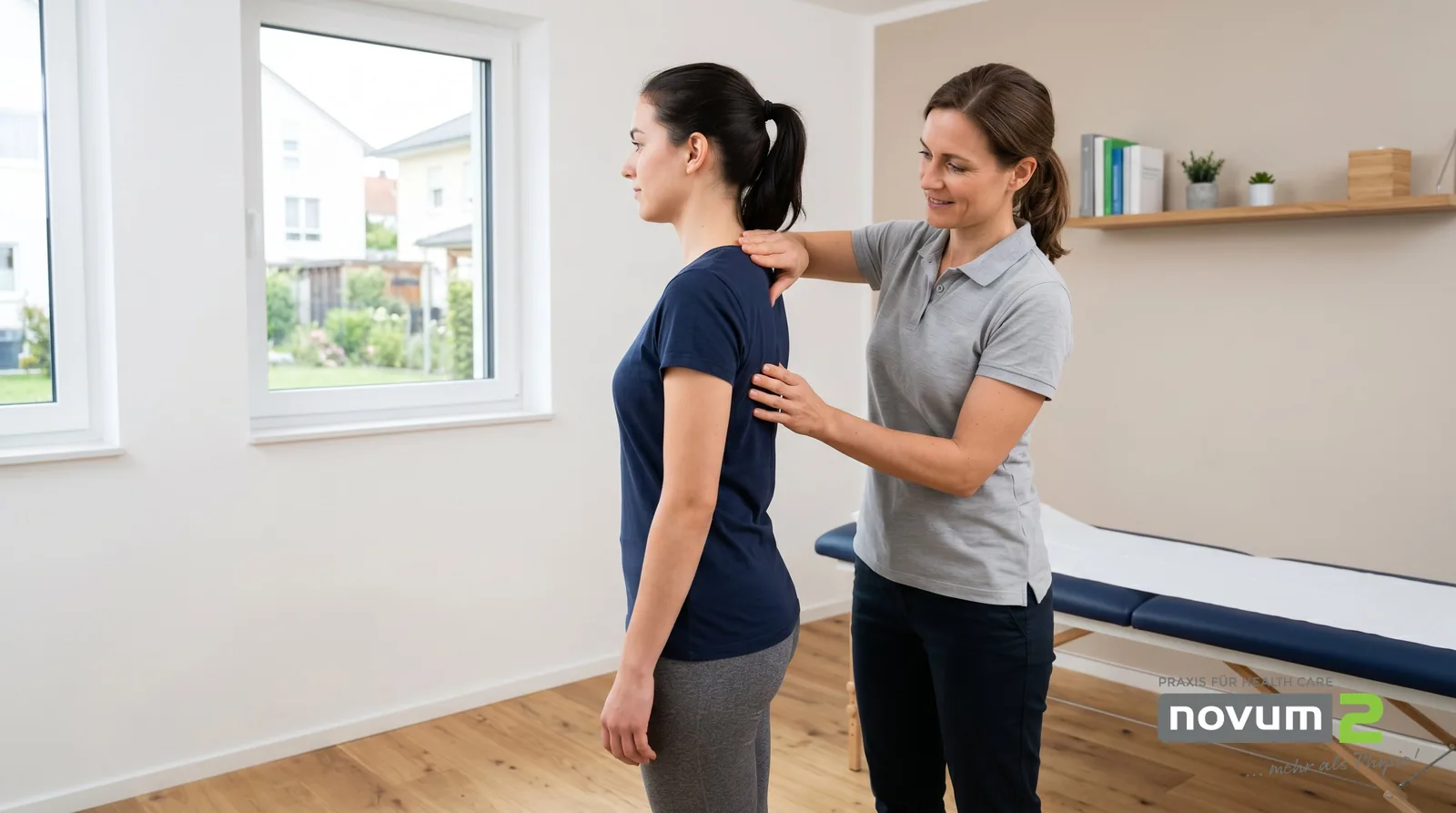
Many people first notice scoliosis through external changes. Uneven shoulders, an unevenly positioned pelvis or a rib hump visible when bending forwards are frequent first signs. At our physiotherapy practice at Ebertplatz in Cologne, we support people who have received a diagnosis of scoliosis and want to know what it means for their everyday life. This guide explains how scoliosis develops, how it is diagnosed and what physiotherapy options exist.
What is scoliosis?
Scoliosis describes a lateral curvature of the spine that becomes visible on an X-ray. The spine not only deviates sideways but simultaneously rotates around its own axis. Doctors speak of scoliosis when the Cobb angle (the measure of the strength of the curvature on the X-ray) is at least 10 degrees.
The most common form is idiopathic scoliosis. "Idiopathic" means: the exact cause is unknown. It develops mainly during the growth phase, especially in girls between 10 and 16 years of age. There are also structural scolioses, caused by diseases of the nervous system or the muscles, and congenital forms caused by vertebral malformations.
Causes of scoliosis
In idiopathic scoliosis, no single cause can be named. Genetic influences play a role: in around 10 percent of cases there are other affected people in the family. A widespread misconception is the assumption that poor posture or certain sports could cause scoliosis. There is no medical basis for this.
Structural scolioses have organic causes, for example neurological disorders, muscle diseases (myopathies) or congenital vertebral changes. These forms require close medical supervision and often an interdisciplinary treatment approach.
Symptoms: how to recognise scoliosis
Scoliosis does not always cause pain, particularly at a younger age. Often the first things to attract attention are physical changes that seem inconspicuous at first glance:
- Asymmetrical shoulder position or unevenly protruding shoulder blades
- Uneven hip height or a tilted pelvis
- A rib hump when bending forwards, more prominent on one side
- An uneven waist triangle on the two sides
- Clothing that sits crookedly or seems to fall to one side
A simple forward-bend test (Adams test) can provide initial clues. When bending forwards with straight legs, people with scoliosis often show a visible unevenness in the back. This test does not replace a medical examination but is suitable for initial orientation.
Diagnosis and severity: the Cobb angle explained
The diagnosis is made by a doctor on the basis of a physical examination and an X-ray. The central measure is the Cobb angle: it indicates by how many degrees the spine deviates laterally from a straight line.
- Under 10 degrees: normal variation, no scoliosis
- 10 to 20 degrees: mild scoliosis (around 75 percent of cases)
- 20 to 40 degrees: moderate scoliosis
- Over 40 degrees: severe scoliosis
In children and adolescents, the Risser stage is also important. It describes the maturity of the skeleton based on the iliac crest and indicates how much growth is still to be expected. A low maturity level with a larger Cobb angle means an increased risk of further progression of the curvature.
Treatment options for scoliosis
Treatment depends on the severity, age and stage of growth. Four approaches are fundamentally available, and they are often combined.
Active observation
For mild curves under 20 degrees during the growth phase, doctors initially recommend regular check-ups, usually every four to six months. As long as the curvature does not increase, no further treatment is needed for the time being.
Physiotherapy
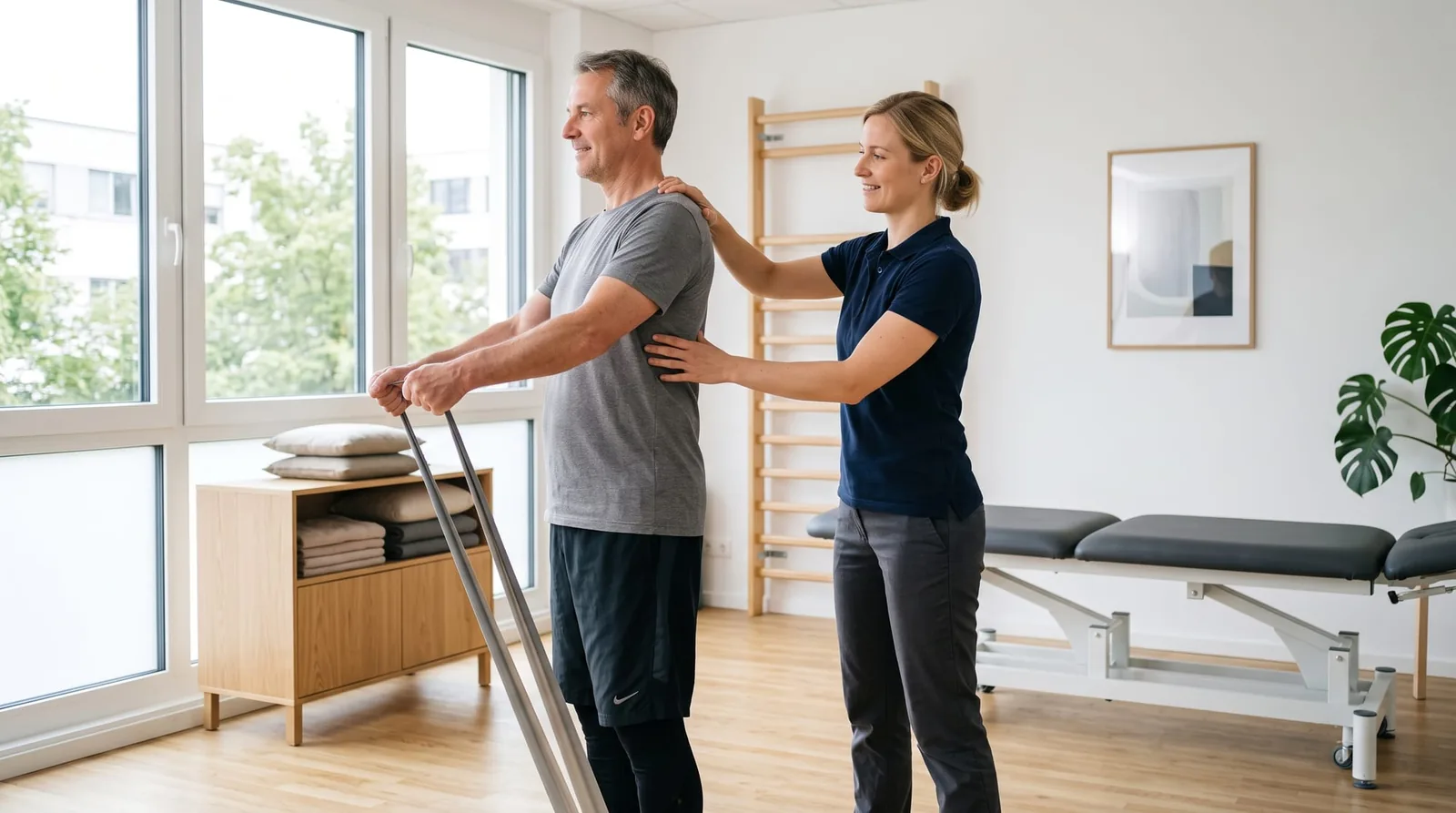
Physiotherapy is a central building block of conservative therapy for scoliosis. It can help strengthen the trunk muscles, maintain the mobility of the spine and improve body awareness. Targeted exercises and specialised techniques such as the Schroth method are frequently used in physiotherapy practice.
Brace treatment
For moderate curves between roughly 25 and 40 degrees during the growth phase, a brace can be used. It exerts targeted pressure on the spine and is intended to slow further progression of the curvature. A brace does not eliminate the scoliosis but can slow its progression. It complements physiotherapy and does not replace it.
Surgery
Surgery is considered for severe curves over 40 to 50 degrees when conservative measures are insufficient. The spine is stabilised with rods and screws and the curvature is largely corrected. This procedure is reserved for severe cases.
The Schroth method and physiotherapy exercises
The Schroth method is a specialised physiotherapy approach aimed at the three-dimensional correction of the spinal curvature. Developed by Katharina Schroth, it combines several elements:
- Three-dimensional breathing techniques to create space on the sunken side of the body
- Targeted strengthening of the weakened muscles along the spine
- Conscious posture correction through improved body feeling and self-perception
- Stretching and mobilisation exercises for the spine and ribcage
The principle is active participation. Those affected learn to consciously straighten their spine against the direction of the curvature. This technique requires regular practice and works best in combination with accompanying therapeutic guidance.
Besides the Schroth method, other exercises can be considered depending on the individual findings: strengthening exercises for the deep trunk muscles, stretching exercises for the shortened muscles on the convex side, and coordination and balance exercises. You will find additional ideas for home in our article on back training at home.
Sport and everyday life with scoliosis
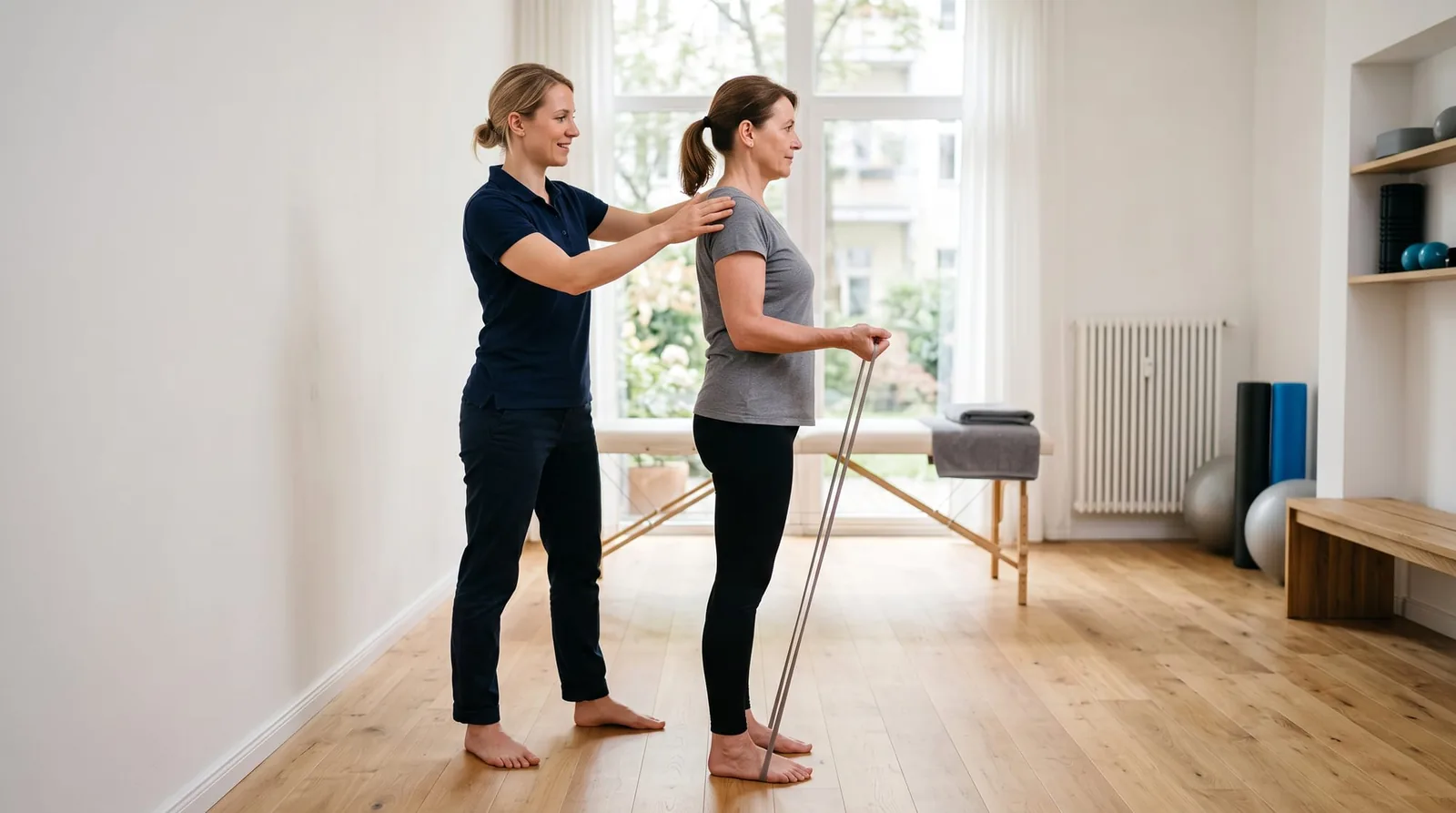
Scoliosis does not mean having to give up sport. Exercise is expressly recommended because it strengthens the trunk muscles, maintains mobility and promotes general well-being. Swimming, cycling, hiking or yoga, for example, are well suited. Discuss which sports suit you best with your doctor or physiotherapist.
In everyday life, it is worth paying attention to an ergonomically adjusted workplace and regular movement breaks. One-sided sustained loading should be avoided. Since scoliosis affects the entire spine, complaints can also occur in the thoracic spine, as described in our article on thoracic spine restrictions. The same applies to the cervical spine, which our article on cervical syndrome covers.
Physiotherapy for scoliosis in Cologne
At our physiotherapy practice Novum2 at Ebertplatz 2 in Cologne, we support people with scoliosis with a comprehensive, evidence-based approach. Together with you, we look at your individual situation: the severity of the curvature, your complaints and your everyday life.
Our team helps you develop the right physiotherapy strategy. That can be the Schroth method, targeted strengthening exercises or a combination of different approaches. You can reach us Monday to Friday during our opening hours (Fridays until 4:10 pm). Book your appointment on +49 221 1693 8485 or via our contact form.